Boring Guardrails Make AI Features Better
Why practical AI guardrails are product decisions, not just technical controls.

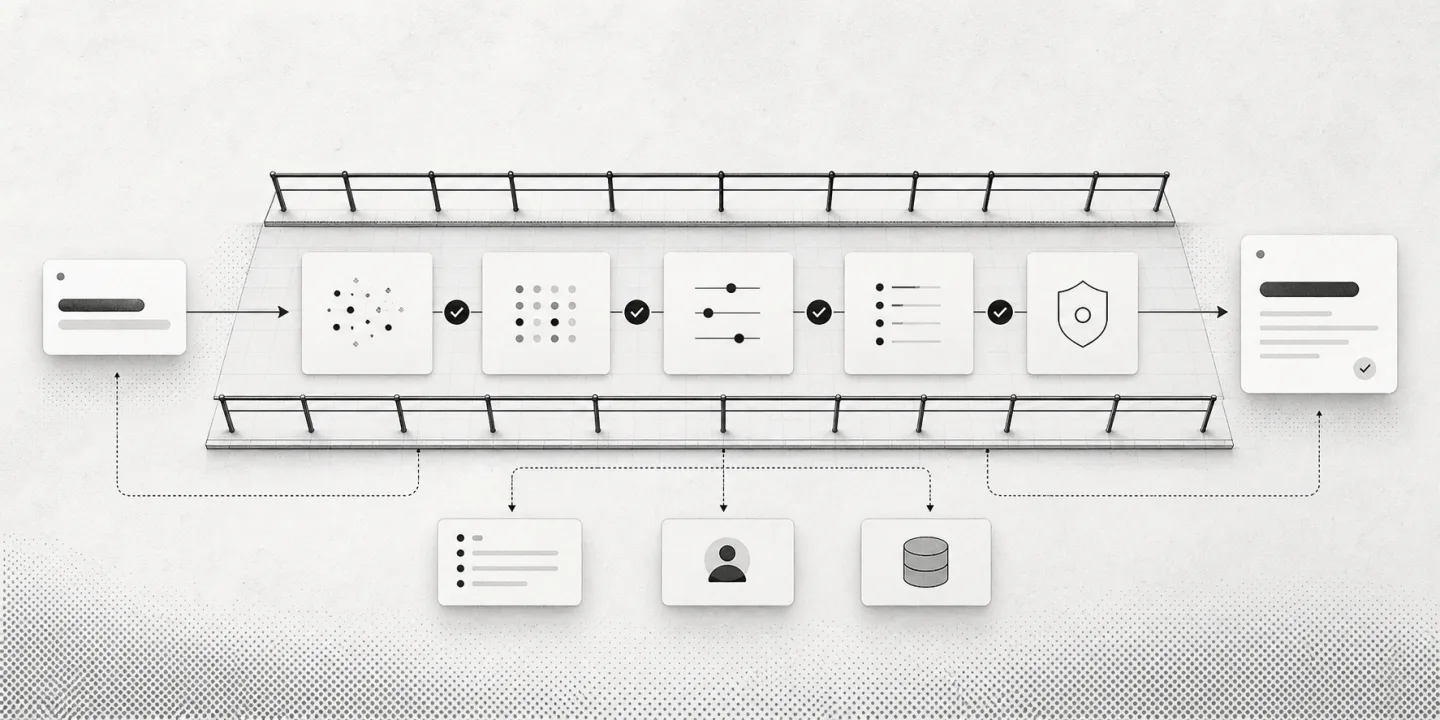
The best AI guardrails do not feel dramatic. They feel boring in the same way seatbelts are boring. You do not think about them when everything is fine, but you are grateful they exist when something goes wrong.
I have become more convinced of this as AI systems move from experiments into actual workflows. The feature might look simple from the outside: ask a question, get an answer, move faster.
Inside the system, there is more going on.
Guardrails are product decisions
A guardrail is not only a technical control. It is a statement about what the product is willing to do.
Should the assistant answer without a source? Should it summarize private data? Should it make a recommendation when confidence is low? Should it ask a follow-up question instead of guessing?
These are engineering questions, but they are also product questions.
When teams skip them, the model fills the gap with confidence. That can look impressive for a while. It can also create trust problems quickly.
The boring checklist works
For AI features, I like having a plain checklist:
- Clear input limits
- Source-aware answers when retrieval is involved
- Logging that helps us debug without exposing sensitive data
- Evaluation examples for normal and weird cases
- A fallback path when confidence is low
- Human review for workflows with real risk
- Cost and latency tracking from the start
None of this makes a good conference demo by itself. But it makes the product safer to use.
That matters more.
Users should not have to understand the model
Most users do not care about the architecture. They care whether the product helps them do their job without creating new problems.
If an AI feature needs a long explanation before someone can trust it, the design is probably not finished. The system should make its boundaries visible through the experience.
Sometimes that means refusing a request. Sometimes it means showing sources. Sometimes it means saying, "I need more context." Sometimes it means handing off to a person.
That is not a failure. That is good software.
Trust is earned quietly
I do not want AI products that feel like a magic trick every time. I want AI products that become dependable enough to fade into the workflow.
Boring guardrails help with that. They make the feature less flashy and more useful.
That is a trade I will take almost every time.